PROMs Collection Is Now Mandatory for Medicare. Here Is What Your Hospital Needs to Know.
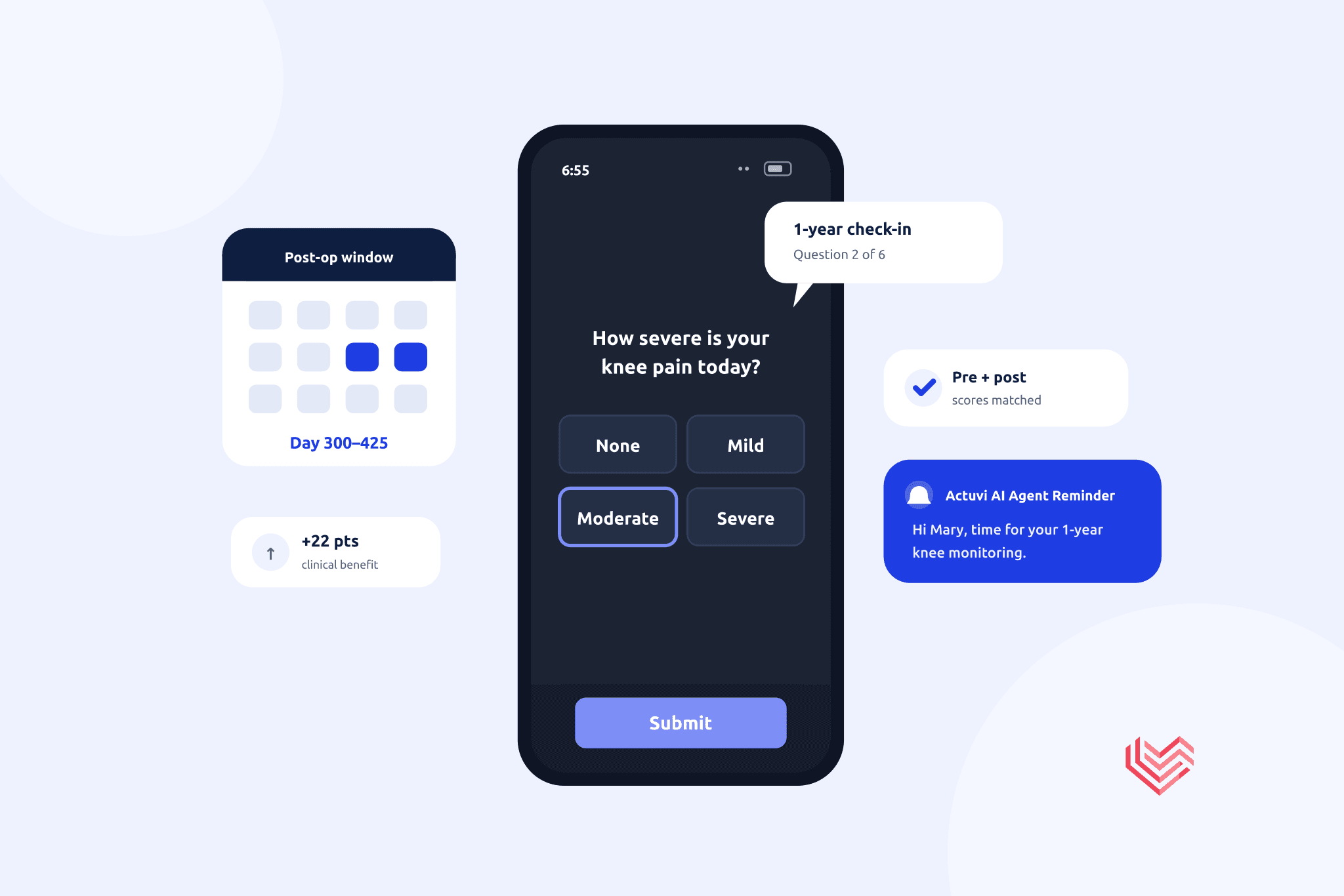
Every hospital performing elective total hip or total knee arthroplasty on a Medicare patient became subject to a new CMS rule on July 1, 2024: collect patient-reported outcome measures before and after surgery, match them, and submit the data. Hospitals that fail to report complete datasets for at least 50% of eligible patients lose 25% of their Annual Payment Update across all Medicare Fee-for-Service Part A claims, including non-orthopedic claims. The same failure disqualifies the hospital from participating in Medicare value-based purchasing programs.
The 2024 American Joint Replacement Registry Annual Report found one-year PROM response rates of 25% to 32% for primary hip and knee arthroplasty patients. Broader literature puts the range at 20% to 40% across most centers. Those numbers were published before the mandate took effect, and they are the baseline most hospitals are working from.
The gap between what CMS now requires and what most hospitals can execute is operational, not clinical.
What CMS requires
The THA/TKA PRO-PM (Patient-Reported Outcome-Based Performance Measure) was finalized in the FY 2023 Inpatient Prospective Payment System Final Rule. It requires hospitals to collect validated PROMs, the HOOS Jr. for hip patients and the KOOS Jr. for knee patients, at two time points: within 90 days before surgery and between 300 and 425 days after surgery.
Both scores must be matched for each individual patient. Submitting a preoperative HOOS Jr. for a patient without the corresponding postoperative score does not count. The data has to close the loop.
CMS will publicly report each hospital’s risk-standardized improvement rate, the percentage of patients who achieved a substantial clinical benefit after their procedure, defined as a gain of at least 22 points on the HOOS Jr. or 20 points on the KOOS Jr. That number will appear on Care Compare for patients and referring providers to see.
CMS ran two voluntary reporting periods before mandatory collection began with procedures performed on or after July 1, 2024. The first payment impact lands in FY 2028.
The penalty hits the whole hospital
CMS does not reduce payment only on hip and knee claims. A hospital that misses the 50% reporting threshold takes a 25% reduction of its Annual Payment Update on every Medicare Fee-for-Service Part A inpatient claim it submits that year, and it loses eligibility for value-based purchasing incentive payments at the same time.
For a hospital processing thousands of Medicare inpatient admissions across cardiology, general surgery, neurology, and every other department, that reduction adds up fast. A failure in one department’s data collection workflow affects the entire institution’s Medicare reimbursement.
Why collection rates are so low
The preoperative side is manageable. Patients are in the building. Staff can hand them a tablet or a paper form, and most hospitals report reasonable preoperative completion rates.
The postoperative side is where it falls apart. The collection window opens 300 days after surgery and closes at 425 days. The patient has been home for almost a year, is not scheduled for a visit, and has moved on. A hospital performing 500 joint replacements a year would need to individually contact several hundred patients per month at the one-year mark just to maintain collection rates above 50%.
Paper forms make it worse. The error rate is high and the turnaround is slow.
TEAM adds another layer
The Transforming Episode Accountability Model went into effect on January 1, 2026. It is mandatory for 741 acute care hospitals across 188 markets. Under TEAM, hospitals assume financial risk for the cost and quality of five surgical episodes from admission through 30 days post-discharge: major joint replacement of the lower extremity, surgical hip and femur fracture treatment, spinal fusion, coronary artery bypass graft, and major bowel procedures.
TEAM’s quality measure set includes the THA/TKA PRO-PM for hospitals performing those procedures. This is a separate but overlapping requirement from the Hospital IQR PRO-PM, and for hospitals that land in both programs, there is no room to deprioritize PROM collection.
The financial stakes in TEAM are direct. Hospitals that deliver care below the bundled target price and meet quality benchmarks earn reconciliation payments. Those that exceed the target price pay CMS back. Post-discharge costs, including readmissions and post-acute care, count toward the episode total, and according to ATI Advisory, between 18% and 52% of spending in the five covered episodes occurs in the post-acute setting. Collecting outcome data from patients after they leave the hospital is built into both the quality scoring and the reconciliation math.
Outpatient settings are on the same path
CMS adopted the THA/TKA PRO-PM for the Hospital Outpatient Quality Reporting Program and the Ambulatory Surgical Center Quality Reporting Program in the CY 2024 OPPS/ASC Final Rule. Voluntary reporting runs from CY 2025 through CY 2027 in both programs. Mandatory reporting begins with the CY 2028 reporting period, tied to the CY 2031 payment determination. Hospital outpatient departments will need matched data for at least 50% of eligible procedures, and ASCs for at least 45%. Facilities that miss the requirement take a 2 percentage point reduction to their annual payment update.
This matters because joint replacement keeps shifting to outpatient settings. Cases reported to the American Joint Replacement Registry by ambulatory surgical centers grew nearly 300% between the 2021 and 2024 Annual Reports, and many of those facilities have even less infrastructure for post-discharge patient follow-up than hospitals do.
Getting above 50%
Five capabilities separate hospitals that clear the threshold from hospitals that miss it.
Digital delivery. Patients need to receive the questionnaire on their phone, not in the mail. Electronic patient-reported outcome collection (ePRO) produces meaningfully higher completion rates than paper forms, especially at the postoperative time point when patients are not coming into the building.
Automated scheduling and reminders. The 300-to-425-day postoperative window requires the collection platform to trigger the assessment automatically at the right time and follow up when the patient does not respond. Staff should not be tracking dates manually for hundreds of patients.
Multiple channels. A 2026 Sinch survey found that 90% of patients prefer text messaging for healthcare communication, ahead of email at 59%, patient portals at 55%, and phone calls at 34%. Platforms that can deliver assessments via SMS, not just through an app or a portal, will reach patients that other methods miss.
Caregiver and guardian access. Joint replacement patients skew older, and some cannot operate a smartphone independently. If a caregiver or family member can submit the assessment on the patient’s behalf, the hospital captures data it would otherwise lose. Without this, the denominator of eligible patients stays the same while the numerator drops.
Pre-and-post matching. CMS requires matched pairs. The collection workflow needs to track whether each patient has both a preoperative and postoperative score on file, because an unmatched baseline contributes nothing to the reporting threshold.
CMS is building this into everything
The THA/TKA PRO-PM is where CMS started. It will probably not be where CMS stops.
The CMS ACCESS Model, a voluntary program launching July 5, 2026, introduces outcome-aligned payments for behavioral health (depression and anxiety, measured via PHQ-9 and GAD-7) and musculoskeletal pain. Payment under ACCESS is tied directly to measured clinical improvement, not service volume. Organizations participating in ACCESS will need to demonstrate that patients are getting better, which means collecting validated patient-reported outcome data before, during, and after treatment.
CMS also adopted the Information Transfer PRO-PM, a measure of patient understanding of recovery information after outpatient procedures, into the Hospital Outpatient Quality Reporting Program, with mandatory reporting beginning in CY 2027, and added it to TEAM for performance years three through five. CMS proposed the same measure for ambulatory surgical centers in the CY 2026 OPPS/ASC Proposed Rule and held off on finalizing it after commenters raised concerns about low survey response rates. The collection problem is now shaping federal rulemaking itself.
CMS is building a framework where patient-reported data is a standard component of quality reporting and reimbursement across care settings and condition types. Hospitals and clinics that build PROM and PREM collection infrastructure now will be ready. Those that treat it as a one-off compliance project for orthopedics will have to rebuild every time CMS expands the requirements.
How Actuvi collects PROMs and PREMs at scale
Actuvi is an award-winning, FDA-listed digital care and ePRO platform that collects PROMs and PREMs through its mobile app, with automated assessment scheduling, push notification reminders, and AI Agents that deliver assessments directly via text message for patients who do not respond through the app.
The platform supports validated instruments including the PHQ-9 and GAD-7 alongside custom assessments built for specific clinical needs. Assessments can be scheduled at any interval, including the 300-to-425-day postoperative window that CMS requires for the THA/TKA PRO-PM. When a patient misses an assessment, Actuvi’s AI Agents follow up via text message, deliver the questionnaire in the conversation, and log the responses on the staff dashboard.
For patients who cannot self-report, Actuvi’s Guardian Access feature allows a caregiver or family member to submit data on the patient’s behalf from their own device. The app also works offline, saving responses locally and syncing when connectivity returns.
The staff dashboard tracks completion rates and missed assessments for every patient, notifies the care team when a patient has not completed an assessment, and delivers regular program reports. The platform generates exportable reports that support claims submission and quality reporting.
Actuvi launches digital care programs with zero IT burden for your care team. The Actuvi team builds the assessments, configures the monitoring tracks, trains staff, and provides ongoing support.
Schedule a demo to see how Actuvi collects PROMs and PREMs at the scale CMS now requires.
Sources
American Academy of Orthopaedic Surgeons, “AAOS Resources Support PROM Adoption Amid New CMS Reporting Requirements,” AAOS Now, January 2026. https://www.aaos.org/aaosnow/2026/jan/research/research01/
AAOS, “The Mandatory CMS IQR THA/TKA PRO-PM,” AAOS Registries & Quality Collaborations. https://www.aaos.org/registries/quality-collaborations/iqr-resources/
AAOS, “CMS Inpatient Quality Reporting PRO-PM FAQ.” https://www.aaos.org/globalassets/quality-and-practice-resources/patient-reported-outcome-measures/pro-pm-frequently-asked-questions-fact-sheet.pdf
American College of Surgeons, “Transforming Episode Accountability Model,” ACS Advocacy. https://www.facs.org/advocacy/team/
CMS, “Transforming Episode Accountability Model (TEAM) Fact Sheet.” https://www.cms.gov/files/document/team-model-fs.pdf
ATI Advisory, “TEAM Readiness: Analytics & Benchmarking,” 2024. https://atiadvisory.com/resources/team-readiness-analytics-benchmarking-2/
CMS, “Calendar Year 2026 Hospital Outpatient Prospective Payment System (OPPS) and Ambulatory Surgical Center Proposed Rule (CMS-1834-P),” Fact Sheet, July 2025. https://www.cms.gov/newsroom/fact-sheets/calendar-year-2026-hospital-outpatient-prospective-payment-system-opps-ambulatory-surgical-center-0
CMS, “Calendar Year 2026 Hospital Outpatient Prospective Payment System (OPPS) and Ambulatory Surgical Center Final Rule (CMS-1834-FC),” Fact Sheet, November 2025. https://www.cms.gov/newsroom/fact-sheets/calendar-year-2026-hospital-outpatient-prospective-payment-system-opps-ambulatory-surgical-center
Behavioral Health Business, “Early Participants of CMS ACCESS Model See Program as Accelerant for Value-Based Care,” April 2026. https://bhbusiness.com/2026/04/15/early-participants-of-cms-access-model-see-program-as-accelerant-for-value-based-care/
Sinch Engage, “The State of Patient Communication in 2026.” https://sinch.com/engage/resources/business-messaging/patient-communication-in-healthcare-2026/
CodeTechnology, “Breaking Down CMS’ OPPS/ASC Final Rule: THA/TKA PRO-PM,” on the CY 2024 OPPS/ASC Final Rule. https://www.codetechnology.com/blog/breaking-down-the-cms-final-rule-the-pro-pm-for-outpatient-tha-tka/