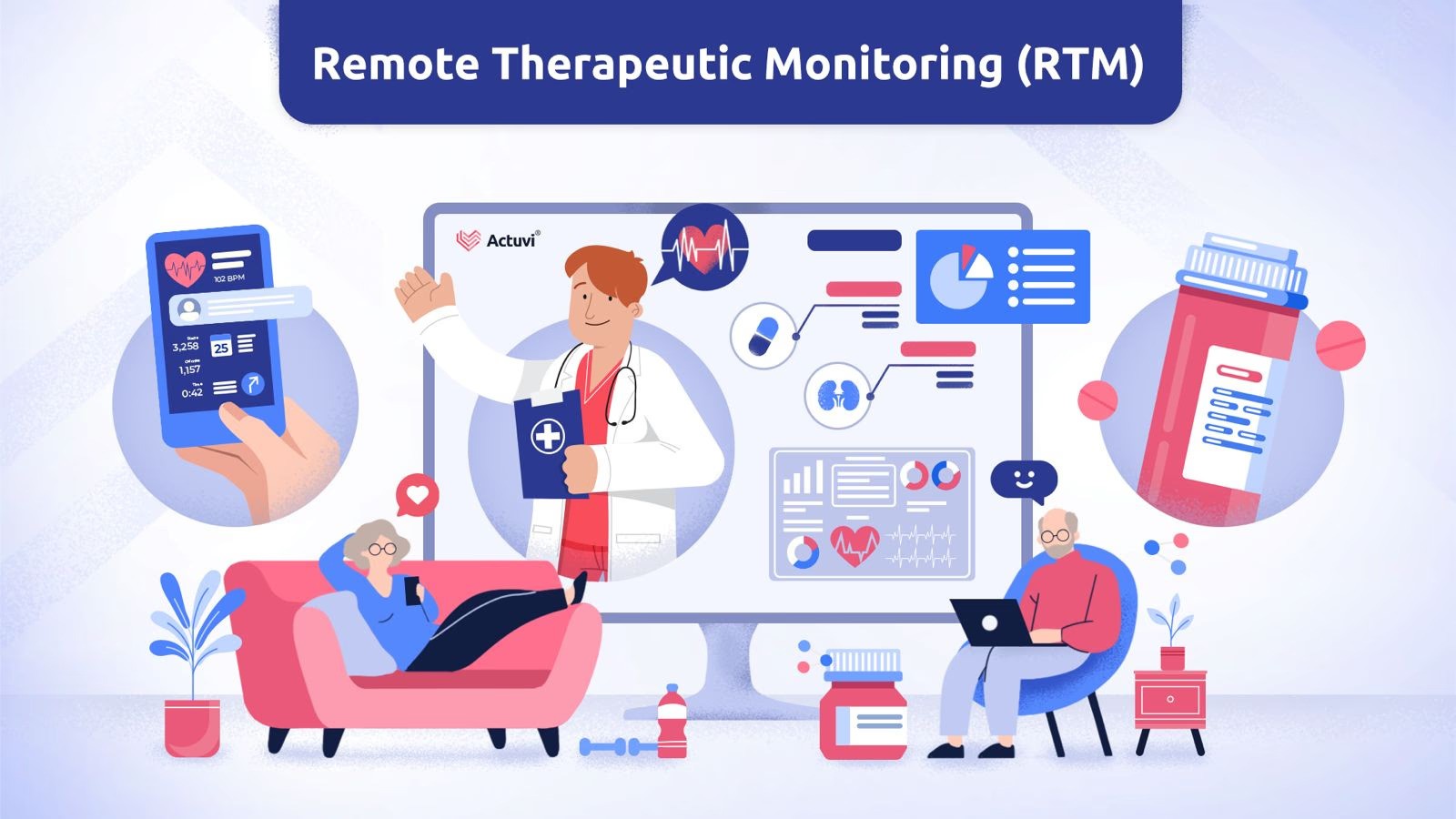
Remote Therapeutic Monitoring (RTM) allows providers to bill for monitoring patient-reported, non-physiological data, such as pain levels, mood scores, exercise completion, and therapy adherence, between visits.
CMS introduced the first RTM billing codes in 2022 for musculoskeletal and respiratory conditions. In 2024, it added cognitive behavioral therapy (CBT). In 2026, it expanded the code set again, lowering billing thresholds and adding two new CPT codes that make RTM accessible to a wider range of patients and clinical workflows.
How Remote Therapeutic Monitoring (RTM) Works
There are three stages to a functioning RTM program.
Setup. The clinic defines which patients to enroll, which conditions to monitor, what assessments patients will complete, and who on the care team is responsible for reviewing incoming data. Patients are onboarded onto an RTM platform like Actuvi, and the monitoring program begins.
Patient data submission. Patients submit data on a defined schedule through an RTM platform like Actuvi (via app, web, or AI messaging), with no dedicated hardware required. Assessments can include conditional logic: if a patient reports high pain, a follow-up question appears automatically; otherwise it is skipped. Alert thresholds are set per question, so staff only get notified when something is genuinely off.
Treatment management. Designated care team members review incoming data on the staff dashboard, respond to alerts, communicate with patients, and log their time. A platform like Actuvi automatically tracks that time, maintains the auditable documentation required for billing, and generates billing reports. That logged time is what drives reimbursement.
What Data Remote Therapeutic Monitoring (RTM) Collects
RTM captures non-physiological, patient-reported data. That means information the patient reports about how they feel and how they are functioning, not readings from a wearable device.
Examples of RTM data types include pain levels, mood, anxiety levels, depression scores, sleep quality, fatigue, medication adherence, exercise completion, functional status, energy levels, cognitive function scores, stress levels, breathing difficulty, and more.
Who Can Bill for Remote Therapeutic Monitoring (RTM)
Providers who are eligible to bill Medicare directly for their services and whose scope of practice includes RTM are eligible to order and bill for it. Eligible provider types include physicians, physical therapists, occupational therapists, speech-language pathologists, nurse practitioners, psychologists, clinical social workers, physician assistants, registered dietitians, and more.
PTAs and COTAs under general supervision can contribute to treatment management time, but must apply the CQ (PT assistant) or CO (OT assistant) modifier to the claim. In all cases, practitioners must comply with applicable state law and scope of practice requirements.
The 2026Remote Therapeutic Monitoring (RTM) CPT Codes
The 2026 CMS Physician Fee Schedule Final Rule brought the most significant RTM expansion since the program launched. Two new codes were added, thresholds were lowered, and reimbursement rates increased across several existing codes.
Full 2026 RTM Code Set
CPT Codes | Description | Billing Frequency | Reimbursement ($) |
98975 | Initial set-up & patient education | Once per episode | 21.71 |
98984/5/6 | RTM device & data transmission (2-15 days) | Once every 30 days | 51.44 |
98976/7/8 | RTM device & data transmission (16-30 days) | Once every 30 days | 51.44 |
98979 | First 10-19 minutes of RTM treatment management | Once per calendar month | 26.39 |
98980 | First 20 minutes of RTM treatment management services | Once per calendar month | 54.11 |
98981 | Each additional 20 minutes of RTM treatment management | Multiple times per calendar month | 41.42 |
What the 2026 Changes Mean in Practice
Before 2026, RTM required 16 days of patient data transmission per month and 20 minutes of provider management time before any reimbursement could be claimed. The new codes drop that floor significantly.
CPT 98984 and 98985 allow billing after just 2 days of data transmission in a 30-day period, down from 16. CPT 98979 allows billing after 10 minutes of treatment management time, down from 20.
For clinics with short-term patients, post-surgical cases, or patients who submit data inconsistently, these codes open up billing pathways that simply did not exist before.
Billing Rules to Know
The device supply codes are mutually exclusive. Bill either 98984 or 98985 (2 to 15 days) or 98976, 98977, or 98978 (16 to 30 days) for a given patient in a given 30-day period, never both.
The treatment management base codes are also mutually exclusive. Bill either 98979 (10 to 19 minutes) or 98980 (20 or more minutes) for the same patient in the same calendar month. Once 20 minutes is reached, switch to 98980. CPT 98981 (each additional 20 minutes) can only stack on top of 98980, not on top of 98979.
Providers are only eligible to bill the treatment management codes if at least one interactive communication with the patient occurs during the calendar month.
Up to $180 Per Patient Per Month
A fully optimized RTM patient, with device supply billed at the 16 to 30 day threshold and 20 or more minutes of treatment management time, can generate approximately $180 per patient per month. Clinics that reach that threshold across a meaningful portion of enrolled patients are adding significant monthly revenue without adding patient volume.
Best Practices for Launching a Remote Therapeutic Monitoring (RTM) Program
The difference between an RTM program that runs for five years and one that stalls by month four usually comes down to decisions made before launch.
Before You Go Live
Define roles before day one. A 100-patient RTM program can run with one or two staff members, but only if it is clear who handles program management, who onboards new patients, and who reviews incoming data daily. Unassigned tasks get dropped. Decide before go-live, not after.
Profile your patient panel first. Not every patient in a given specialty qualifies. Insurance mix, condition type, and patient digital literacy all factor in. Know the rough enrollment volume and likely conditions before building assessments. Skipping this step creates bottlenecks on day one.
Set enrollment milestones at 1, 3, and 6 months. Without targets, it is hard to tell whether the program is growing as expected or quietly underperforming. Define what success looks like at each stage before launching.
At Patient Onboarding
Walk every patient through the platform before they leave the clinic. Compliance drops sharply when patients leave without completing setup. The first check-in submission should happen during the onboarding conversation.
Three things determine whether a patient engages or ignores the program: they understand why it matters to their care, they know exactly what is expected of them, and they make some form of commitment before leaving. Clinics that skip this step see low submission rates within the first two weeks.
Ongoing Program Management
Build staff incentives in from the start. A common approach is to use the 98975 setup reimbursement to reward staff for successful patient onboarding. Programs without any staff incentive ramp up more slowly and see higher early dropout.
Track patient compliance as a program metric. Enrollment numbers look healthy on paper, but they hide the patients who signed up and stopped submitting. Review submission rates monthly per patient, so the program manager can spot where compliance is slipping before it shows up in the billing report.
Refine assessments over time. The best programs adjust monitoring tracks as clinical needs evolve. An assessment built at launch will not be the right assessment at month twelve. Build in a quarterly review of what patients are being asked and whether the questions are generating useful clinical data.
Getting Started with Actuvi
Actuvi is an award-winning RTM platform, built to run RTM programs across all specialties.
Most software vendors hand clinics a platform and leave them to figure the rest out. Actuvi works differently. The Actuvi team handles setup, configuration, and staff training, and stays involved to keep patient compliance high and the program running the way it was designed to.
Our team will send you the full breakdown. Keep an eye on your inbox.
Book a call and get it now